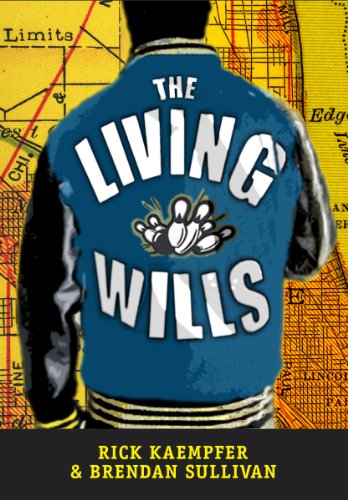
Recently, I read The Living Wills, which is a novel that at first seems disparate because it opens up with various characters that you think are disconnected, but in the end have some important connections. Also, you find out what is up with Henry, a Vietnam vet, whom you meet at the beginning of the story and who seems like a minor character, but he is not, and you see how people and events swirl around him. Basically, he had an experience in Vietnam that changed him forever, and he affected other people along the way.
At the beginning, the story seems slow and details unnecessary, but they end up making sense because mysterious elements are revealed as the story unfolds. The book is written well and is entertaining. I wouldn't be surprised if it ends up becoming a movie.
I interviewed the two guys who wrote the book together: Rick Kaempfer and Brendan Sullivan.
Why did you choose to write a book together?
Brendan: I pitched the idea to Rick to use the collaborative creativity techniques I teach my corporate clients to use, to apply these concepts to create a novel. It was an experiment. We used improv, brainstorming, mind mapping and other ideation tools.
Rick: Honestly, it was an experiment in my mind. I knew that Brendan and I got along, that our writing styles were similar, and that we were both pretty open minded. It seemed like a good pairing to me.
How long did it take you to write the book?
Brendan: I first pitched the idea to Rick in January 2009. The book was published in December 2011.
How did you know how to edit your ideas into a coherent story?
Rick: That first few times we met at the Catalyst Ranch we really hashed out which parts of the story worked together, and which parts needed to be dumped. From that point on, we were on our way, although we still required...
Brendan: ...Lots of editing, reading one another's stuff, having pre-readers give us feedback, and then feedback from a professional editor.
What inspired you to write this story?
Brendan: My mother was a strong inspiration. She always told me I could do whatever I set my mind to, and she instilled in me a strong sense of family, which is a theme of the book.
Rick: And for me, it was my dad. He died when I was in my 20s, before I was married or had kids, and I didn’t really start writing until he was gone. I wanted to chronicle things for my own kids so that they would know what their father was thinking—if like my own dad—I’m not around when they finally care what I have to say. That process unleashed a passion for writing in me. That’s why Brendan and I dedicated the book to his mom and my dad.
How did you come up with the plot?
Brendan: We generated way too much initial content and lots of three-dimensional characters, then filtered it. We had long ideation sessions loaded with wild ideas, we filled flipcharts with all sorts of possibilities, and then chose those that fit together the best.
Rick: That’s true. We really did create the characters before we created the plot. I think that’s probably an unusual way of doing it. But by the time we started working on the plot, we knew these characters like the back of our hands. That made the plot easier to create, and took us in directions that we never would have gone if he had written the plot first.
Did you know the ending before you wrote the whole thing?
Brendan: We had all 60 or so chapters beated out before we began to write a first draft of the novel. This helped us avoid painting ourselves into a corner. It was crucial that we knew where we were going. We made some changes along the way, but the main structure of the story was set in the first six months of the process, before we typed "Chapter One" on a page.
Rick: Right. We knew the ending, but as it turns out, we didn’t really know what we would find during the writing process. We found all sorts of things, including the main message of the book, which emerged organically. That was a real revelation to me.
The book seems like a weaving of different people and stories that eventually come together and make sense. Why did you decide to have it unfold like that?
Brendan: That structure evolved from the creative process. We began by generating a LOT of story lines, and then we considered which ones were most viable and how these might intersect. We chose three stories. It loosely follows the improvisational theater form called the "Harold" where three scenes begin separately and over the course of a live performance, intersect to become one piece.
Rick: I’ve always been a fan of the kind of novels that have intersecting story lines like this. One of my favorite things about Dickens (my favorite writer) is that he has his characters turning up in unusual and unexpected parts of the story. That appeals to me as a reader, so I thought it would be fun as a writer too.
Did you wonder if the reader would be patient for the story to unfold instead of including a clear inciting incident that fiction seems to have?
Brendan: There was a concern that some readers might read the first few chapters and be confused because each of those early chapters appears to be disconnected from the others. The payoff is for those readers who have stuck with it past the first three chapters. Readers have consistently told us that the slow unfolding and connecting of the stories was an enjoyable revelation.
Rick: We have heard from a few people that it took awhile to get into it. It’s a pretty complex story. But if you trust that your questions will be answered, you will not be disappointed.
Why have several characters instead of one main one?
Brendan: Well, again I don't believe it was a conscious choice but something that evolved from the process. If there is a lead character, it would be Henry, whose life touches all of the others in a profound way. The story is about relationships, and how everything is connected. Three story lines required a lot of strong characters.
Rick: That’s true. I consider Henry the lead character too. He is the glue to this story—the thing that ties them all together.
How did you know readers would be able to relate to the story? Did you have an audience in mind?
Brendan: The story is about normal, real people dealing with real challenges. These are the people I have observed all my life, doing things anyone can relate to. We didn't have a particular audience in mind because we didn't want to change anything just because it would be "more marketable." That didn't seem honest. So there are no teenage vampires in the book, as much as we knew that it might sell a few more copies.
Rick: Shhhhhh! There are all sorts of teenage vampires in this book. I don't know what Brendan is talking about. Teenage vampire fans should buy hundreds of copies of "The Living Wills" and distribute it to their friends.
Why did you choose Vietnam as a prominent part of the story?
Brendan: Our character, Henry, needed to be affected by a powerful event to explain his ensuing actions and decisions throughout his scattered adult life. Vietnam fit. I've also always been impressed by the 'silent warrior' who does his duty for his country and doesn't want to be treated as a hero, who would rather just move on. Of course Henry can't really move on, although he would also never admit that.
Rick: Both Brendan and I are a little too young to have been in Vietnam, but our generation was definitely influenced and touched by it. We all know people that served. For me, it was my Uncle Manny. We used to send him audio tapes so that he could get a taste of home. I’ll never forget the day he came home safe and sound.
The book is good--how did you learn how to write so well?
Brendan: Thanks! Personally, I read a lot. I think a writer learns from other writers. I've always enjoyed the power of the written word to move people, to make them laugh and cry. One way or another, I've been writing for over 40 years now. I couldn't have written this when I was 20 or 30 or 40 years old. I wasn't ready.
Rick: It’s funny, but English isn’t even my first language. I couldn’t diagram a sentence to save my life. But I’ve always been able to tell a story, and to me that’s what writing is all about.
What did you learn from this creative process? Is there anything you learned not to do?
Brendan: I learned that it can work. Two independent, professional, creative individuals can come together and create a novel. Two heads, in this case at least, are indeed better than one. I learned not to get too attached to any material, and to not let my ego get in the way.
Rick: I also learned how valuable it could be to have another set of eyes looking at it the entire way. We do look at things slightly differently, and he saw some things that I didn't see--and vice versa. As for what not to do, don't try to start giving names of characters to nieces and nephews and in-laws. You're bound to forget someone, and then you'll just have to write another book to make up for that.
Do you plan on writing another book together?
Brendan: I would very much like to try it again, knowing what we know now.
Rick: I’d like to give it a shot too. I think first we’re going to tackle the screenplay to this book. We’ve already had a few inquiries from filmmakers, and that has given us the kick in the pants we need to get going on that.
Author of WICKER PARK WISHES, a novel, published by Eckhartz Press "It's like 'Hi Fidelity' from a woman's perspective. A 90s book about relationships." - John Siuntres, WordBalloon. Language discussion and expression, a view from the city: "A fascinating and enlightening look at language and other important matters" - Rick Kogan, Chicago Tribune "...definitely an interesting voice!" - Languagehat.com "...a great site!" - Mary Beard, Times Literary Supplement
4.14.2012
4.06.2012
Take the train west
I didn't post anything here during the past week because I took a train to Los Angeles, then stayed out there for a few days, and wow, do I feel refreshed and relaxed. I highly recommend taking a train out west (or east if you're already out there).
My husband and I took the Southwest Chief line (an image of the map is below, thanks to Amtrak) and got a bedroom sleeper, which included a sink, combo shower/toilet, a couch, and chair. At night, the couch became a bed, and there's an upper bed that can pull out, so three people can fit in there. Neither of us are tall, so we didn't feel cramped, though it seems like the roomette is really tight. Meals were included, and the views were great.
Once we got to Colorado, I noticed that the earth was more reddish-orange, and in New Mexico, it really was red. The most visually interesting part of the trip was from Flagstaff, when it went through the rest of New Mexico into Arizona. I'm sure you've seen lots of pictures of the rocks and landscape of Arizona, but seeing it in person is amazing. Before Flagstaff we passed through mountains, which were of course beautiful, but the colors west of there were breathtaking.
If you get a chance, take a train across the west. You'll see that the USA is vast and beautiful, and you'll arrive at your destination relaxed.
My husband and I took the Southwest Chief line (an image of the map is below, thanks to Amtrak) and got a bedroom sleeper, which included a sink, combo shower/toilet, a couch, and chair. At night, the couch became a bed, and there's an upper bed that can pull out, so three people can fit in there. Neither of us are tall, so we didn't feel cramped, though it seems like the roomette is really tight. Meals were included, and the views were great.
Once we got to Colorado, I noticed that the earth was more reddish-orange, and in New Mexico, it really was red. The most visually interesting part of the trip was from Flagstaff, when it went through the rest of New Mexico into Arizona. I'm sure you've seen lots of pictures of the rocks and landscape of Arizona, but seeing it in person is amazing. Before Flagstaff we passed through mountains, which were of course beautiful, but the colors west of there were breathtaking.
If you get a chance, take a train across the west. You'll see that the USA is vast and beautiful, and you'll arrive at your destination relaxed.
3.29.2012
I wish I knew more about this Japanese fan
I was looking online for Japanese kanji iPhone apps, and found some reviews at Zonjineko. I don't think there are that many anymore, since the review is from a couple of years ago, but the post made me look around his site. It seems to be great for Japanese language and cultural info. Unfortunately, he doesn't say much about himself in his bio, but I wonder if Japanese is just a hobby or part of his work. He goes there (often?) and takes photos, including signs, which is my personal passion (I take pics around Chicago and when I visit other places...which I really should post on Flickr and here), and it's just an interesting site all around.
Actually, he has a good post about not giving up studying Japanese, and in it, he uses the word "Mum" instead of "Mom", so I wonder if he's a Brit or part of that world.
Check it out--he's so organized and seems to consistently post substantial content, which I've been having trouble with lately :| He even has a newsletter you can subscribe to!
Actually, he has a good post about not giving up studying Japanese, and in it, he uses the word "Mum" instead of "Mom", so I wonder if he's a Brit or part of that world.
Check it out--he's so organized and seems to consistently post substantial content, which I've been having trouble with lately :| He even has a newsletter you can subscribe to!
3.22.2012
the BBC doesn't have a Japanese news section
I was talking to a Polish-born coworker the other day (he immigrated during his university years and became a US citizen) about good news sites, other than the Polish ones he reads, and he recommended the BBC. I agree; it's a great site with informative, multimedia features and has a good learning English section. I noticed that they offer news in several languages, but Japanese isn't there! I'm surprised...they have other Asian languages, including the ones that aren't widely spoken. Why there's no Japanese, I don't know.
Since Japanese wasn't there, I decided to check out the Portuguese section, which of course is easier to read than Japanese, even though I don't know all the words.
Another incredible feature at the site is learning languages! They have several, including Japanese, though I'm seriously interested in improving my German. At one point, my German ability wasn't bad, and now it's awful. I even took a trip there, and was eventually able to function in German, but now, I don't think I'd be able to manage it :(
I'm assuming the BBC is publicly funded...way to go and thank you very much for providing such a great service!
Since Japanese wasn't there, I decided to check out the Portuguese section, which of course is easier to read than Japanese, even though I don't know all the words.
Another incredible feature at the site is learning languages! They have several, including Japanese, though I'm seriously interested in improving my German. At one point, my German ability wasn't bad, and now it's awful. I even took a trip there, and was eventually able to function in German, but now, I don't think I'd be able to manage it :(
I'm assuming the BBC is publicly funded...way to go and thank you very much for providing such a great service!
3.17.2012
Bruce Lee drawing
Kesan, aka the funny Chinese clown, drew this image of Bruce Lee, and added his screen name in Chinese, 李小龍 "Xiaolong", which according to Wikipedia means "little dragon". I think it's cool. (Kesan's last name is Li, btw...same sound as "Lee".)
Ever since I saw Enter the Dragon when I was in Asia, I have liked Lee because he achieved a balance between the East and the West in that film. Actually, it was on TV the other day, and I saw it again, which means I've seen the movie several times at this point. Too bad he passed away so young :(
3.15.2012
Royce and Tali come to Chicago this Saturday
I met Royce Deans five years ago through Deviantart, and since that time, he's really been doing a lot with art and has expanded his projects. He and Tali Farchi formed a painting endeavor called Paint in Action, where they do live painting to music. I've seen it myself, and it's pretty cool. One or more musicians will play music, and they will paint as a response to it, and their art is projected onto a wall. They post their finished pieces in the gallery where they are working and online.
They've been in Chicago a couple of times, and they're coming again this Saturday, March 17 to participate in The Chicago Loop Colorboration Project. Tali will be in town until April 11 and Royce will be here until April 24. But you should check out the website for the latest info as changes occur.
The location where they will be painting with live music (different musicians and groups every day) is at 208 S. Wabash (here's a map). It will take place from March 17 - April 24. There will also be an Artist Reception on Thursday, March 22, from 5pm to 10pm. I usually work at night, but I'm going to try to make it early, around 5 pm, or late, around 9 pm. See you there!
They've been in Chicago a couple of times, and they're coming again this Saturday, March 17 to participate in The Chicago Loop Colorboration Project. Tali will be in town until April 11 and Royce will be here until April 24. But you should check out the website for the latest info as changes occur.
The location where they will be painting with live music (different musicians and groups every day) is at 208 S. Wabash (here's a map). It will take place from March 17 - April 24. There will also be an Artist Reception on Thursday, March 22, from 5pm to 10pm. I usually work at night, but I'm going to try to make it early, around 5 pm, or late, around 9 pm. See you there!
3.08.2012
Sarah Vowell: the un-celebrity
Sometimes I get a glimpse of showbiz when I go to Chicago Live because I edit some shows for broadcast on the radio. I've met various interesting people, and tonight, I got a chance to see and meet Sarah Vowell, who has one of the most amazing careers on the planet.
I sat very close to the stage (thanks to the Second City folks at their new club), so I could see what she was like. She wore casual clothes that were not colorful, just gray and black, practical boots, and no makeup. Actually, I think she was wearing foundation or something that people "should" wear on stage. But she looked natural. She was intelligent, witty, and didn't smile as she delivered her dry lines.
Compare such a performance to most women in the biz: they're usually animated, wear makeup, and try to smile to get the audience's approval. Sarah is lucky because she doesn't have to do that. In fact, I bet it would ruin her reputation. Imagine making a living in the public eye being yourself and using your intellect to express yourself. Rare. Very rare.
After the show, I went to the book table to tell her that she's really blessed because of all that she's achieved without having to act or look a certain way, and she didn't really have much of a response. But at least I got to say it!
I sat very close to the stage (thanks to the Second City folks at their new club), so I could see what she was like. She wore casual clothes that were not colorful, just gray and black, practical boots, and no makeup. Actually, I think she was wearing foundation or something that people "should" wear on stage. But she looked natural. She was intelligent, witty, and didn't smile as she delivered her dry lines.
Compare such a performance to most women in the biz: they're usually animated, wear makeup, and try to smile to get the audience's approval. Sarah is lucky because she doesn't have to do that. In fact, I bet it would ruin her reputation. Imagine making a living in the public eye being yourself and using your intellect to express yourself. Rare. Very rare.
After the show, I went to the book table to tell her that she's really blessed because of all that she's achieved without having to act or look a certain way, and she didn't really have much of a response. But at least I got to say it!
3.03.2012
Apostrophe flow chart
Finally, someone has explained correct apostrophe use with a graphic *and* text...thanks to HGPublishing for posting this.
2.28.2012
Interview with Rick Kaempfer, author of $everance
Rick Kaempfer is a successful Chicago writer who wrote the excellent book $everance, which is a satire about the radio industry.
Why did you write this book?
I started writing this book in my head while I was still employed in radio, and just couldn't believe what I was seeing during the deregulation era. The entire industry was being transformed, and not in a good way. I consider my first book The Radio Producer's Handbook my love letter to the industry, and $everance my "Dear John" letter to the industry, formally breaking up with it.
Why did you break up with it?
I could see the direction it was headed, and I no longer wanted to be a part of it. Providing a quality product literally didn't mean anything anymore. I would sit in promotion meetings and ask questions like "Why would the listeners want to hear this?" and they would reply "Our customer is not the listener. Our customer is the client." I knew enough people in the business to know this was happening at all of the big corporately owned radio stations, so I had two choices at that point. Re-calibrate my brain to think that way, or break up with them until they regained their sanity.
What in your own radio experience shaped this book?
There were three main things that happened directly to me that made me realize this "five or six companies owning everything" media could be headed for disaster. The first one was the time I was called into my general manager's office and ordered to write a letter to the F.C.C. supporting further deregulation. I said to him, "but I don't agree with that." And he said, "If you don't write it, you'll be fired." I buckled and told him I would write it, though I never did.
The second incident occurred a few years later. Our morning show started the show every day with the National Anthem sung by the Dixie Chicks. When the Dixie Chicks got into hot water for criticizing the president, we were ordered to stop playing it. When I pointed out that we weren't getting complaints about it, and after all, it was the National Anthem, I was told that we would be fired if we played it again. And the last thing thing that influenced me was the last few months of my time at WJMK, when the station clearly didn't want us anymore, so they tried to make us miserable, hoping we would quit and forfeit our severances.
The first incident opened my eyes to the new realities of corporate owned radio. The second incident opened my eyes to the possibility of the media being used to further a political agenda (not to mention the ease with which a group could be blackballed when only a few companies owned everything). And the last incident gave me the idea for the plot of the novel.
Why did your general manager care about furthering deregulation? When he threatened you, could you go to some legal authority to file a complaint?
He cared about furthering deregulation because he owned a ton of stock, and he knew that he would be personally enriched in the short term. I kid you not, the day it went through, he held a staff meeting, and said to everyone, "I just got off the phone with my broker and he said 'Congratulations, you're f***** rich!'" Talk about an awkward moment. That was so strange.
As for filing a complaint, I didn't want to be branded as a troublemaker. I never really considered it, because every avenue led to "you'll never work in this business again."
Did you get your severance?
We did get our severance.
Why choose satire fiction? Why not write a non-fiction book or essay about the radio business?
I purposely chose satire because I wanted to point out how ridiculous the media world already was--and how much more ridiculous it could become. A few of things I predicted in the story as a joke have actually come true since the book came out. The ridiculous cost cutting (way beyond what anyone anticipated), the creation of a liberal clone of Fox News (MSNBC), the Nascarization of television (the ads all over the screen all the time), the rigged game on Wall Street (remember, this was written before the collapse of 2008). I thought it was satire, but it turned out to be true. So maybe it really is non-fiction. :)
By doing a satire, were you afraid of sounding preachy?
I never really considered satire to be preachy. It's more like "Please tell me I'm not the only one seeing this." If I am the only one seeing it, it's not funny, and the whole book is a failure. If I'm not the only one seeing it, the satire works. It's a big risk, I suppose. But I figured that since my publisher instantly saw it as "a truth that needs to be told", I wasn't alone.
Did anyone from such companies as Clear Channel complain?
The companies themselves didn't complain about the book, but I did run into a few radio and television personalities that said things to me like "Oh man I loved the book, but you know we're owned by Clear Channel (or CBS or whatever), don't you? My boss would kill me if I had you on the show." I did learn something important about the business during the publicity portion of the book. If you're criticizing the media, it's not that easy to get coverage in the media. (I eventually found ways around it, but only because I personally know so many media personalities). I was very pleasantly surprised how well the book sold under the circumstances. Remember, all of the major publishing houses are also owned by the media giants, so there was no way I was going to get this published by a major publisher. ENC Press (a boutique New York publisher) was willing to take a chance on me because they wanted this message to get out there too, and I'll always be grateful to them for that.
I didn't expect any complaints, so I wasn't surprised I didn't get any. The thesis of my book is that the only thing they care about, and I really mean literally the only thing they care about, is the price of the stock and the amount of money they personally make. As long as my book didn't affect that in any way, and of course it didn't, I was invisible to them.
Has your book influenced anyone in the business?
I'm not sure if my book has influenced anyone, but I do know that the big companies I skewered in the book like Clear Channel and CBS have begun to realize the mistakes that were made. I'm told that sales departments and programming departments are working together much better than they used to. That's a step in the right direction. Both sides used to feel a sort of "you're nothing without me" attitude towards the other, and while that was true (you have to have content in order to sell, and you have to have sales in order to survive), it was needlessly antagonistic. The hard times in the industry forced the two sides to get along a little better. At least that's what people have told me. I'm not in the trenches anymore, so I can't officially confirm whether or not that's true. I hope it is.
Do you think the radio business will fail?
No, I don't think the radio business will fail. It just has too much to offer. It may change, and it may change drastically, but it still offers a valuable service to the community--especially if it provides local content.
Who did you base the characters on?
The characters are pretty obviously fictionalized versions of the real media tycoons of that era (early-to-mid 00s). I read everything I could about all of them, and discovered that they shared certain traits and characteristics. Each of them was wildly interesting and entertaining in their own way, and though each of them were rich beyond their wildest dreams, they were, to a man, miserable and incredibly disliked by everyone that knew them. That was my leaping off point. From there, I just let my imagination run wild.
How did you maintain your narrative voice?
The narrative voice was something that came naturally to me. The main character, Zagorski, was someone I knew. It was a mixture of people I had worked with and for, with a pinch of me thrown in there. I witnessed so many radio personalities exhibiting Zagorski's righteous indignation for all of the wrong things, he almost wrote himself. As for the other characters, I felt like I personally knew them too. I had read just about everything written about all the media moguls, I knew exactly how to passive-aggressively confront them if I ever got the chance. Zagorski got the chance, and boy was that fun to write. Keeping a consistent narrative voice under those circumstances was incredibly easy.
How do you write a novel?
There are so many different ways to write a novel and I've now written three of them in three different ways, so there's no obviously no correct way to do it. I still think the best way is to know the ending and to work backwards from there, but with my latest novel The Living Wills we didn't do it that way, and it also worked out just fine. The most important thing is that you need to motivate yourself to keep on writing. Find ways to reward yourself along the way. Finished the chapter! Cheers! Finished the first draft! Cheers! Finished the second draft! Cheers! Got a publisher! Got a cover! Etc. By the time you get the actual copy of the book in your hand you've celebrated a zillion times. Then again, maybe I'm just a lush, looking for an excuse to celebrate.
Did you do an outline?
Yes, I did do an outline. A pretty extensive one. I had to create an entire imaginary media world, so I had a big chart on my wall as I wrote, showing me which mogul controlled which company. I created a company profile of each little subsidiary. Then I mapped out each individual chapter and began to write.
How did you know how to craft a good chapter, and how did you know when it was finished, and done well?
I knew what had to be included in the chapter, information wise, to progress the plot and story line, but I left myself the freedom to write it in whatever location I chose at that moment. That made it more fun for me--and provided some of the funnier moments in the book. I always knew where the story was going, but the fun was going to be in the journey, and not so much in the destination, so each chapter had to have a life of it's own. So, I wrote and re-wrote each chapter, and then read it out loud until it sounded just right, and limited myself to a chapter a day to make sure I didn't take any shortcuts. And I concentrated on making sure the ending of the chapter wasn't an ending, as much as it was a prelude to the next chapter.
How do you stay motivated and know when it sounds right without an editor checking it, and how can you write without feedback from an outside person? I'm asking this because I find it difficult to write for long periods of time with no external feedback or audience.
I pride myself in my ability to self-motivate...but I get your point about outside feedback. My wife really helps me out with that--at least she did during the writing of $everance. She's very good at smaller picture issues like grammar and verb usage, and she's a tough critic. She won't hesitate to tell me when it's not up to snuff, or when something doesn't make sense. For the big picture items, my editor at ENC Press helped me realize I was over-explaining things--and guided me how to better use subtext. She also pointed out which characters needed to be fleshed out and which ones needed to be eliminated. I found out pretty quickly that I had a gifted editor on my hands.
What is your writing approach?
I'm an incredibly disciplined writer, but that's mainly out of necessity. I'm at home with my kids, so my work day is really limited to the time they are in school. So, I start writing the moment the last kid leaves for school, and I stop writing the moment the first kid comes home from school. At night after the kids go to bed I plan out what I'm going to write the following day and let it gestate in my brain, so that I can hit the ground running.
Even without responsibilities, people would still not have such discipline. How did you develop it, or was that just part of your personality?
I'd say it's not really a part of my personality, because in every other way I'm a lazy sack. I just happen to love writing, and I feel so lucky to have been given the opportunity to do it for a living. I don't want to do anything to screw it up. I was the same way when I was working in radio. Even though I had issues with the business, I never had issues with creating radio shows. That creative process was exhilarating. I absolutely loved it. Nobody was more surprised than I was when I found something I loved even more. Writing gives me all the thrills creative radio gave me, and I don't have to get up at 2AM to experience it. Honestly, these last five or six years have just been bliss for me.
Writing is a solitary endeavor. How do you deal with working like that? Do you balance working alone with socializing? And was working in radio more social?
Radio was way more social than writing, no doubt about it, but I kind of like the solitude of writing. I still get plenty of social interaction through my kids, my friends, and my various interview projects, so I don't feel like I'm missing out. I always say, imagine how much work you would get done if nobody interrupted you for six hours every day. I really concentrate virtually of my writing into those six hours, and I love it.
Is the key to publishing/writing success to know people in the media so that you can get coverage? Does media coverage lead to sales success, or is it possible to achieve that without media coverage?
Media coverage does lead to sales success, but only if the product is good. If you have bad word of mouth once people start reading your book, then all the media coverage in the world won't help. There are lots of ways to get media coverage these days, without knowing someone in the traditional media. The internet and social media are great equalizers now, but they weren't powerful yet when $everance came out. Facebook was still in it's infancy, and Twitter didn't even exist (or at least I had never heard of it). One of the reasons I started my blog in the first place was that I wanted a place to promote my writing; a place to build an audience. When $everance came out I was only getting about a hundred hits a day, so it didn't help me much at the time. Since then, the audience for my blogs (I have several) has grown to over a million visitors a year, so now it's a viable platform--and I've seen how much it helped sales with my latest book The Living Wills.
What's a good way to build an audience? How did yours grow so large?
I think the key is to be as professional as possible. I was accustomed to coming up with a ton of material every day when I was a radio producer, and I just continued doing that on my blog. I quickly found out what stuff interested people and what stuff didn't, based on audience reaction, and it slowly built from there.
My Chicago Radio Spotlight blog started at a time when Robert Feder was briefly absent from the scene (after his time at the Sun-Times), and I think people were starved for information about radio folks. I know Larz at the Chicagoland Radio and Media site gave me a few plugs and that certainly helped. My Just One Bad Century website started up the season the Cubs looked like they were going to put it all together, and it garnered a lot of attention that year, which has translated into a fairly loyal audience. My Father Knows Nothing column was just a lark at first--I started that because I wanted to chronicle the childhood of my kids for their future adult selves to enjoy--and it caught on unexpectedly. Last year I was a finalist for a Chicago Headline Club Peter Lisagor Award for that column...losing out to Roger Ebert. Along the way I've been asked to do media interviews about all of these blogs/websites, and that has also expanded the audience.
There are probably very few people that are interested in all three of these subjects (media, Cubs, and parenting), so I've tapped into three totally different types of audiences. I can't say I had this master plan to do it this way--it all sort of just happened. I just follow my own interests, and hope that people follow along.
Since the general theme of this blog is language, I have a language question: you speak German. What is your Germanic background? Do you read German books and magazines?
Yes I do speak German, but we no longer speak it in my mom's house since my father passed away. My mom now generally speaks to us in German, and my brother, sister, and I answer in English.
My mom is from Bavaria (Regensburg), and my father is from Austria (near Vienna), but both of them are ethnically German from Romania (my father was actually born in Romania). Their families fled Romania during the war when the Russians arrived. I was born in Chicago (my parents met here in the late 50s), and then grew up in Heidelberg (in Southwestern Germany) because my father was transferred there by the Department of Defense (he was a civilian in the Corp of Engineers).
I used to read Kicker magazine when I still followed German soccer, but I gave that up more than ten years ago. Now I don't really read German anymore, unless I'm given something to translate.
Why did you write this book?
I started writing this book in my head while I was still employed in radio, and just couldn't believe what I was seeing during the deregulation era. The entire industry was being transformed, and not in a good way. I consider my first book The Radio Producer's Handbook my love letter to the industry, and $everance my "Dear John" letter to the industry, formally breaking up with it.
Why did you break up with it?
I could see the direction it was headed, and I no longer wanted to be a part of it. Providing a quality product literally didn't mean anything anymore. I would sit in promotion meetings and ask questions like "Why would the listeners want to hear this?" and they would reply "Our customer is not the listener. Our customer is the client." I knew enough people in the business to know this was happening at all of the big corporately owned radio stations, so I had two choices at that point. Re-calibrate my brain to think that way, or break up with them until they regained their sanity.
What in your own radio experience shaped this book?
There were three main things that happened directly to me that made me realize this "five or six companies owning everything" media could be headed for disaster. The first one was the time I was called into my general manager's office and ordered to write a letter to the F.C.C. supporting further deregulation. I said to him, "but I don't agree with that." And he said, "If you don't write it, you'll be fired." I buckled and told him I would write it, though I never did.
The second incident occurred a few years later. Our morning show started the show every day with the National Anthem sung by the Dixie Chicks. When the Dixie Chicks got into hot water for criticizing the president, we were ordered to stop playing it. When I pointed out that we weren't getting complaints about it, and after all, it was the National Anthem, I was told that we would be fired if we played it again. And the last thing thing that influenced me was the last few months of my time at WJMK, when the station clearly didn't want us anymore, so they tried to make us miserable, hoping we would quit and forfeit our severances.
The first incident opened my eyes to the new realities of corporate owned radio. The second incident opened my eyes to the possibility of the media being used to further a political agenda (not to mention the ease with which a group could be blackballed when only a few companies owned everything). And the last incident gave me the idea for the plot of the novel.
Why did your general manager care about furthering deregulation? When he threatened you, could you go to some legal authority to file a complaint?
He cared about furthering deregulation because he owned a ton of stock, and he knew that he would be personally enriched in the short term. I kid you not, the day it went through, he held a staff meeting, and said to everyone, "I just got off the phone with my broker and he said 'Congratulations, you're f***** rich!'" Talk about an awkward moment. That was so strange.
As for filing a complaint, I didn't want to be branded as a troublemaker. I never really considered it, because every avenue led to "you'll never work in this business again."
Did you get your severance?
We did get our severance.
Why choose satire fiction? Why not write a non-fiction book or essay about the radio business?
I purposely chose satire because I wanted to point out how ridiculous the media world already was--and how much more ridiculous it could become. A few of things I predicted in the story as a joke have actually come true since the book came out. The ridiculous cost cutting (way beyond what anyone anticipated), the creation of a liberal clone of Fox News (MSNBC), the Nascarization of television (the ads all over the screen all the time), the rigged game on Wall Street (remember, this was written before the collapse of 2008). I thought it was satire, but it turned out to be true. So maybe it really is non-fiction. :)
By doing a satire, were you afraid of sounding preachy?
I never really considered satire to be preachy. It's more like "Please tell me I'm not the only one seeing this." If I am the only one seeing it, it's not funny, and the whole book is a failure. If I'm not the only one seeing it, the satire works. It's a big risk, I suppose. But I figured that since my publisher instantly saw it as "a truth that needs to be told", I wasn't alone.
Did anyone from such companies as Clear Channel complain?
The companies themselves didn't complain about the book, but I did run into a few radio and television personalities that said things to me like "Oh man I loved the book, but you know we're owned by Clear Channel (or CBS or whatever), don't you? My boss would kill me if I had you on the show." I did learn something important about the business during the publicity portion of the book. If you're criticizing the media, it's not that easy to get coverage in the media. (I eventually found ways around it, but only because I personally know so many media personalities). I was very pleasantly surprised how well the book sold under the circumstances. Remember, all of the major publishing houses are also owned by the media giants, so there was no way I was going to get this published by a major publisher. ENC Press (a boutique New York publisher) was willing to take a chance on me because they wanted this message to get out there too, and I'll always be grateful to them for that.
I didn't expect any complaints, so I wasn't surprised I didn't get any. The thesis of my book is that the only thing they care about, and I really mean literally the only thing they care about, is the price of the stock and the amount of money they personally make. As long as my book didn't affect that in any way, and of course it didn't, I was invisible to them.
Has your book influenced anyone in the business?
I'm not sure if my book has influenced anyone, but I do know that the big companies I skewered in the book like Clear Channel and CBS have begun to realize the mistakes that were made. I'm told that sales departments and programming departments are working together much better than they used to. That's a step in the right direction. Both sides used to feel a sort of "you're nothing without me" attitude towards the other, and while that was true (you have to have content in order to sell, and you have to have sales in order to survive), it was needlessly antagonistic. The hard times in the industry forced the two sides to get along a little better. At least that's what people have told me. I'm not in the trenches anymore, so I can't officially confirm whether or not that's true. I hope it is.
Do you think the radio business will fail?
No, I don't think the radio business will fail. It just has too much to offer. It may change, and it may change drastically, but it still offers a valuable service to the community--especially if it provides local content.
Who did you base the characters on?
The characters are pretty obviously fictionalized versions of the real media tycoons of that era (early-to-mid 00s). I read everything I could about all of them, and discovered that they shared certain traits and characteristics. Each of them was wildly interesting and entertaining in their own way, and though each of them were rich beyond their wildest dreams, they were, to a man, miserable and incredibly disliked by everyone that knew them. That was my leaping off point. From there, I just let my imagination run wild.
How did you maintain your narrative voice?
The narrative voice was something that came naturally to me. The main character, Zagorski, was someone I knew. It was a mixture of people I had worked with and for, with a pinch of me thrown in there. I witnessed so many radio personalities exhibiting Zagorski's righteous indignation for all of the wrong things, he almost wrote himself. As for the other characters, I felt like I personally knew them too. I had read just about everything written about all the media moguls, I knew exactly how to passive-aggressively confront them if I ever got the chance. Zagorski got the chance, and boy was that fun to write. Keeping a consistent narrative voice under those circumstances was incredibly easy.
How do you write a novel?
There are so many different ways to write a novel and I've now written three of them in three different ways, so there's no obviously no correct way to do it. I still think the best way is to know the ending and to work backwards from there, but with my latest novel The Living Wills we didn't do it that way, and it also worked out just fine. The most important thing is that you need to motivate yourself to keep on writing. Find ways to reward yourself along the way. Finished the chapter! Cheers! Finished the first draft! Cheers! Finished the second draft! Cheers! Got a publisher! Got a cover! Etc. By the time you get the actual copy of the book in your hand you've celebrated a zillion times. Then again, maybe I'm just a lush, looking for an excuse to celebrate.
Did you do an outline?
Yes, I did do an outline. A pretty extensive one. I had to create an entire imaginary media world, so I had a big chart on my wall as I wrote, showing me which mogul controlled which company. I created a company profile of each little subsidiary. Then I mapped out each individual chapter and began to write.
How did you know how to craft a good chapter, and how did you know when it was finished, and done well?
I knew what had to be included in the chapter, information wise, to progress the plot and story line, but I left myself the freedom to write it in whatever location I chose at that moment. That made it more fun for me--and provided some of the funnier moments in the book. I always knew where the story was going, but the fun was going to be in the journey, and not so much in the destination, so each chapter had to have a life of it's own. So, I wrote and re-wrote each chapter, and then read it out loud until it sounded just right, and limited myself to a chapter a day to make sure I didn't take any shortcuts. And I concentrated on making sure the ending of the chapter wasn't an ending, as much as it was a prelude to the next chapter.
How do you stay motivated and know when it sounds right without an editor checking it, and how can you write without feedback from an outside person? I'm asking this because I find it difficult to write for long periods of time with no external feedback or audience.
I pride myself in my ability to self-motivate...but I get your point about outside feedback. My wife really helps me out with that--at least she did during the writing of $everance. She's very good at smaller picture issues like grammar and verb usage, and she's a tough critic. She won't hesitate to tell me when it's not up to snuff, or when something doesn't make sense. For the big picture items, my editor at ENC Press helped me realize I was over-explaining things--and guided me how to better use subtext. She also pointed out which characters needed to be fleshed out and which ones needed to be eliminated. I found out pretty quickly that I had a gifted editor on my hands.
What is your writing approach?
I'm an incredibly disciplined writer, but that's mainly out of necessity. I'm at home with my kids, so my work day is really limited to the time they are in school. So, I start writing the moment the last kid leaves for school, and I stop writing the moment the first kid comes home from school. At night after the kids go to bed I plan out what I'm going to write the following day and let it gestate in my brain, so that I can hit the ground running.
Even without responsibilities, people would still not have such discipline. How did you develop it, or was that just part of your personality?
I'd say it's not really a part of my personality, because in every other way I'm a lazy sack. I just happen to love writing, and I feel so lucky to have been given the opportunity to do it for a living. I don't want to do anything to screw it up. I was the same way when I was working in radio. Even though I had issues with the business, I never had issues with creating radio shows. That creative process was exhilarating. I absolutely loved it. Nobody was more surprised than I was when I found something I loved even more. Writing gives me all the thrills creative radio gave me, and I don't have to get up at 2AM to experience it. Honestly, these last five or six years have just been bliss for me.
Writing is a solitary endeavor. How do you deal with working like that? Do you balance working alone with socializing? And was working in radio more social?
Radio was way more social than writing, no doubt about it, but I kind of like the solitude of writing. I still get plenty of social interaction through my kids, my friends, and my various interview projects, so I don't feel like I'm missing out. I always say, imagine how much work you would get done if nobody interrupted you for six hours every day. I really concentrate virtually of my writing into those six hours, and I love it.
Is the key to publishing/writing success to know people in the media so that you can get coverage? Does media coverage lead to sales success, or is it possible to achieve that without media coverage?
Media coverage does lead to sales success, but only if the product is good. If you have bad word of mouth once people start reading your book, then all the media coverage in the world won't help. There are lots of ways to get media coverage these days, without knowing someone in the traditional media. The internet and social media are great equalizers now, but they weren't powerful yet when $everance came out. Facebook was still in it's infancy, and Twitter didn't even exist (or at least I had never heard of it). One of the reasons I started my blog in the first place was that I wanted a place to promote my writing; a place to build an audience. When $everance came out I was only getting about a hundred hits a day, so it didn't help me much at the time. Since then, the audience for my blogs (I have several) has grown to over a million visitors a year, so now it's a viable platform--and I've seen how much it helped sales with my latest book The Living Wills.
What's a good way to build an audience? How did yours grow so large?
I think the key is to be as professional as possible. I was accustomed to coming up with a ton of material every day when I was a radio producer, and I just continued doing that on my blog. I quickly found out what stuff interested people and what stuff didn't, based on audience reaction, and it slowly built from there.
My Chicago Radio Spotlight blog started at a time when Robert Feder was briefly absent from the scene (after his time at the Sun-Times), and I think people were starved for information about radio folks. I know Larz at the Chicagoland Radio and Media site gave me a few plugs and that certainly helped. My Just One Bad Century website started up the season the Cubs looked like they were going to put it all together, and it garnered a lot of attention that year, which has translated into a fairly loyal audience. My Father Knows Nothing column was just a lark at first--I started that because I wanted to chronicle the childhood of my kids for their future adult selves to enjoy--and it caught on unexpectedly. Last year I was a finalist for a Chicago Headline Club Peter Lisagor Award for that column...losing out to Roger Ebert. Along the way I've been asked to do media interviews about all of these blogs/websites, and that has also expanded the audience.
There are probably very few people that are interested in all three of these subjects (media, Cubs, and parenting), so I've tapped into three totally different types of audiences. I can't say I had this master plan to do it this way--it all sort of just happened. I just follow my own interests, and hope that people follow along.
Since the general theme of this blog is language, I have a language question: you speak German. What is your Germanic background? Do you read German books and magazines?
Yes I do speak German, but we no longer speak it in my mom's house since my father passed away. My mom now generally speaks to us in German, and my brother, sister, and I answer in English.
My mom is from Bavaria (Regensburg), and my father is from Austria (near Vienna), but both of them are ethnically German from Romania (my father was actually born in Romania). Their families fled Romania during the war when the Russians arrived. I was born in Chicago (my parents met here in the late 50s), and then grew up in Heidelberg (in Southwestern Germany) because my father was transferred there by the Department of Defense (he was a civilian in the Corp of Engineers).
I used to read Kicker magazine when I still followed German soccer, but I gave that up more than ten years ago. Now I don't really read German anymore, unless I'm given something to translate.
2.22.2012
John St. Augustine interview
People who read this blog might be interested in the interview I did with John St. Augustine, who has his own blog and has written a couple of books: Living an Uncommon Life and Every Moment Matters.
I didn't talk to him about the content of his books, but mainly about his positive attitude, his perseverance, and his career, which included working for the Oprah Radio Channel. He also talks about what happened after he took a very long walk from upper Michigan to Chicago.
He's a cool, talented guy who also speaks around the world. Click here to listen to the interview.
I didn't talk to him about the content of his books, but mainly about his positive attitude, his perseverance, and his career, which included working for the Oprah Radio Channel. He also talks about what happened after he took a very long walk from upper Michigan to Chicago.
He's a cool, talented guy who also speaks around the world. Click here to listen to the interview.
2.20.2012
I would be on my way to class now
Today is Presidents' Day, which means I don't have to teach tonight. Usually I'd start wrapping up my day now to get on the road for my annoying commute to the southern part of the city, and I'd usually be tired and would be wondering what happened to my day as it seemed to disappear so quickly. After class I'd *really* be tired and would make the non-annoying commute back home after 10 pm.
I should have planned my day off better. I got a lot of stuff done, and even read a big chunk of my manga, but I still feel like I squandered the time. Perhaps it's because I operated more slowly than usual, and I have a meeting to go to tonight, which means there won't be much time left for reading and finishing up the interview with Rick Kaempfer. Lesson learned!
As it's Presidents' Day in the USA and Family Day in parts of Canada...happy holidays folks!
I should have planned my day off better. I got a lot of stuff done, and even read a big chunk of my manga, but I still feel like I squandered the time. Perhaps it's because I operated more slowly than usual, and I have a meeting to go to tonight, which means there won't be much time left for reading and finishing up the interview with Rick Kaempfer. Lesson learned!
As it's Presidents' Day in the USA and Family Day in parts of Canada...happy holidays folks!
2.14.2012
A Valentine to No One
It's Valentine's Day, which means it's time to share a Valentine to No One:
I can't tell you what I think
I can't tell you how I feel
So I will send a Valentine to No One
A Valentine to No One
Because you'll never know
And you will never care
How much I meant what I said
That I was truly there
You will never know
And you will never care
2.12.2012
Got a new manga
I have been consistently reading Japanese since I finished my third manga, even though I haven't had much time due to my usual complex work schedule and non-work responsibilities.
I bought another manga, the very first one in the Kacho Shima Kousaku (課長島耕作) series, and it's entertaining, though once again I'm puzzled by some of the colloquial phrases. I'm thinking of going over to the library in the Japanese Consulate to ask them what some of them mean. I get the gist, but want to know the exact meaning of what they're saying, and it's sort of annoying to not know :|
I can't sit down for chunks of time to read it, so I end up reading it briefly before I teach or during my break. Also, I'm in the process of interviewing Rick Kaempfer about his excellent book Severence, and I feel bad about putting that to the side while I read the manga, but hey, we have to get our language fix in sometime, n'est-ce pas?
I bought another manga, the very first one in the Kacho Shima Kousaku (課長島耕作) series, and it's entertaining, though once again I'm puzzled by some of the colloquial phrases. I'm thinking of going over to the library in the Japanese Consulate to ask them what some of them mean. I get the gist, but want to know the exact meaning of what they're saying, and it's sort of annoying to not know :|
I can't sit down for chunks of time to read it, so I end up reading it briefly before I teach or during my break. Also, I'm in the process of interviewing Rick Kaempfer about his excellent book Severence, and I feel bad about putting that to the side while I read the manga, but hey, we have to get our language fix in sometime, n'est-ce pas?
1.30.2012
I finished my third manga!
I just finished my third Japanese manga: Young Shima Kousaku (ヤング島耕作), which is a prequel of the Kacho Shima Kousaku (課長島耕作) series.
This one was almost 200 pages. It had lots of drama: office politics, blackmail, romance, cheating, and lots more! That's why I really like these: they're not fantasy but crazy dramas based on real-world work annoyances.
The other two mangas I read were over 200 pages, so I feel quite a sense of accomplishment. The first one I read was this:
And the second one I read was this:
It's difficult to read mangas because sometimes I can't figure out the colloquial phrases, so I'm wondering if I should take a break and read more straightforward Japanese texts to give my mind a rest :D
This one was almost 200 pages. It had lots of drama: office politics, blackmail, romance, cheating, and lots more! That's why I really like these: they're not fantasy but crazy dramas based on real-world work annoyances.
The other two mangas I read were over 200 pages, so I feel quite a sense of accomplishment. The first one I read was this:
And the second one I read was this:
It's difficult to read mangas because sometimes I can't figure out the colloquial phrases, so I'm wondering if I should take a break and read more straightforward Japanese texts to give my mind a rest :D
1.26.2012
Bad typos won't help this biz
I clicked on this internet ad to see what it was all about, and couldn't believe the glaring typos for a service that is language and writing-oriented. We all make mistakes, even after we proofread something a few times. But these show an ignorance that I doubt will help that business.
One typo is the first sentence: "How do one knows..." That's just bad English. They should get a grammar book or at least have someone who knows English to proofread their copy. Another one I noticed was the comma splice in the last sentence.
Some people use comma splices if they want to be extra-casual, but that intentional use comes from stylistic choices, not uninformed ones.
I wonder if other people have noticed these typos and if they will affect this business. I know it didn't impress me. Additionally, it's not just a bad reflection on just this business, but on the one that used it. Should they have corrected his testimonial? I think yes, because they offer writing services, so they should have applied their skills to what he wrote. He is, after all, a happy customer.
One typo is the first sentence: "How do one knows..." That's just bad English. They should get a grammar book or at least have someone who knows English to proofread their copy. Another one I noticed was the comma splice in the last sentence.
Some people use comma splices if they want to be extra-casual, but that intentional use comes from stylistic choices, not uninformed ones.
I wonder if other people have noticed these typos and if they will affect this business. I know it didn't impress me. Additionally, it's not just a bad reflection on just this business, but on the one that used it. Should they have corrected his testimonial? I think yes, because they offer writing services, so they should have applied their skills to what he wrote. He is, after all, a happy customer.
1.20.2012
Jeweler or Jeweller?
I was puzzled when I saw this sign because I thought the "correct" spelling is "jeweler". I put "correct" in quotes because Merriam-Webster lists two spellings. I suspected that it's a British spelling, so I did a search online, and found a number of sites with it, including the British Jewellers Association.
As I'm typing this, Blogger is pointing out that "jeweller" is a misspelling, and word processing programs agree. I wonder if they do the same with "jeweler" over there.
1.17.2012
I'm back! This is what I've been working on...
Happy new year! I think this is the longest I've gone without posting on this blog, but at the end of 2011, I got more radio work (which receded this week), and in addition to that, I was doing my paid writing and teaching gigs, so it didn't leave me much time.
What I've been doing since I've posted here is planning and promoting a free talk about how to create a podcast. Here's the info:
How to Create a Podcast
Saturday, January 28
3-4 PM
Cost: free
Sulzer Regional Library
Community Meeting Room (on the first floor, just inside the entrance)
4455 N. Lincoln Avenue in Chicago (just north of Montrose)
You will learn the basics of creating a podcast: the tools you need, where you can post it online, and tips on creating and promoting content. There will be time for questions and discussion. After you attend, you will be emailed a free PDF with more detailed information about podcasting.
If you have any questions, you can post something here or email me (info AT metrolingua.com).
Actually, I was interviewed about it on Rick Kogan's show this past Sunday (he's the successful media guy who was kind enough to allow me to quote him in the masthead of this blog). Rick Kogan is the best! I'll be doing a blog post about him soon.
What I've been doing since I've posted here is planning and promoting a free talk about how to create a podcast. Here's the info:
How to Create a Podcast
Saturday, January 28
3-4 PM
Cost: free
Sulzer Regional Library
Community Meeting Room (on the first floor, just inside the entrance)
4455 N. Lincoln Avenue in Chicago (just north of Montrose)
You will learn the basics of creating a podcast: the tools you need, where you can post it online, and tips on creating and promoting content. There will be time for questions and discussion. After you attend, you will be emailed a free PDF with more detailed information about podcasting.
If you have any questions, you can post something here or email me (info AT metrolingua.com).
Actually, I was interviewed about it on Rick Kogan's show this past Sunday (he's the successful media guy who was kind enough to allow me to quote him in the masthead of this blog). Rick Kogan is the best! I'll be doing a blog post about him soon.
12.14.2011
Sweden is not in Eastern Europe
I thought Whole Foods was more savvy than the average grocery store, but apparently they need some education: they say that these Swedish meatballs are a "taste of Eastern Europe", but Sweden is in Northern Europe. Check your geography, people.
12.11.2011
They should've read their menu before printing it
I saw this at an established, popular restaurant that has been around for years. So you know they have enough money to hire someone to proofread their menus, but apparently they didn't bother to do that. And didn't take the time to check their menu before sending it to print. The mistake is quite glaring--look at the last two sentences: they say that they moved to Broadway, and then in the last sentence, they say "We are pleased to bring our special cooking and deli favorites to Broadway".
Note how there is no period, which is an obvious mistake, but what's odd is that it seems like they are announcing their new location, as if it has just opened. Did they forget to delete that sentence?
The idea doesn't logically flow from the previous sentence or content because they were describing their history, and all of a sudden end the page with the introduction of a new idea and direction. Plus, they've been writing in the past tense, and then switch to present tense. They should have at least created a new paragraph.
Seriously, they should've taken the time to read their menu and should have found someone who could carefully look at it to make sure it made sense. I wonder if other customers have noticed this.
Note how there is no period, which is an obvious mistake, but what's odd is that it seems like they are announcing their new location, as if it has just opened. Did they forget to delete that sentence?
The idea doesn't logically flow from the previous sentence or content because they were describing their history, and all of a sudden end the page with the introduction of a new idea and direction. Plus, they've been writing in the past tense, and then switch to present tense. They should have at least created a new paragraph.
Seriously, they should've taken the time to read their menu and should have found someone who could carefully look at it to make sure it made sense. I wonder if other customers have noticed this.
12.06.2011
A poem inspired by overnight radio
Here's a poem that I saw at Dale Fanella's blog. Dale is a *very* talented and interesting guy who I worked with on a radio show a couple of years ago.
Poem Inspired By Working Overnights In Radio
Underneath my fingertips
60's 70's 80's hits
Overnight at the radio station
The greatest hits are in rotation
A candidate for caffeination
To help combat my deprivation
A cup of Joe, cool water splash
I wish I could go home and crash
A coffee buzz with Tired Eyes
Feeling fried like greasy fries
A catchy song, awake with passion
Eyes wide open never closed like caption
Then Sleep all day miss all the action
I can't get no satisfaction
Subscribe to:
Posts (Atom)


